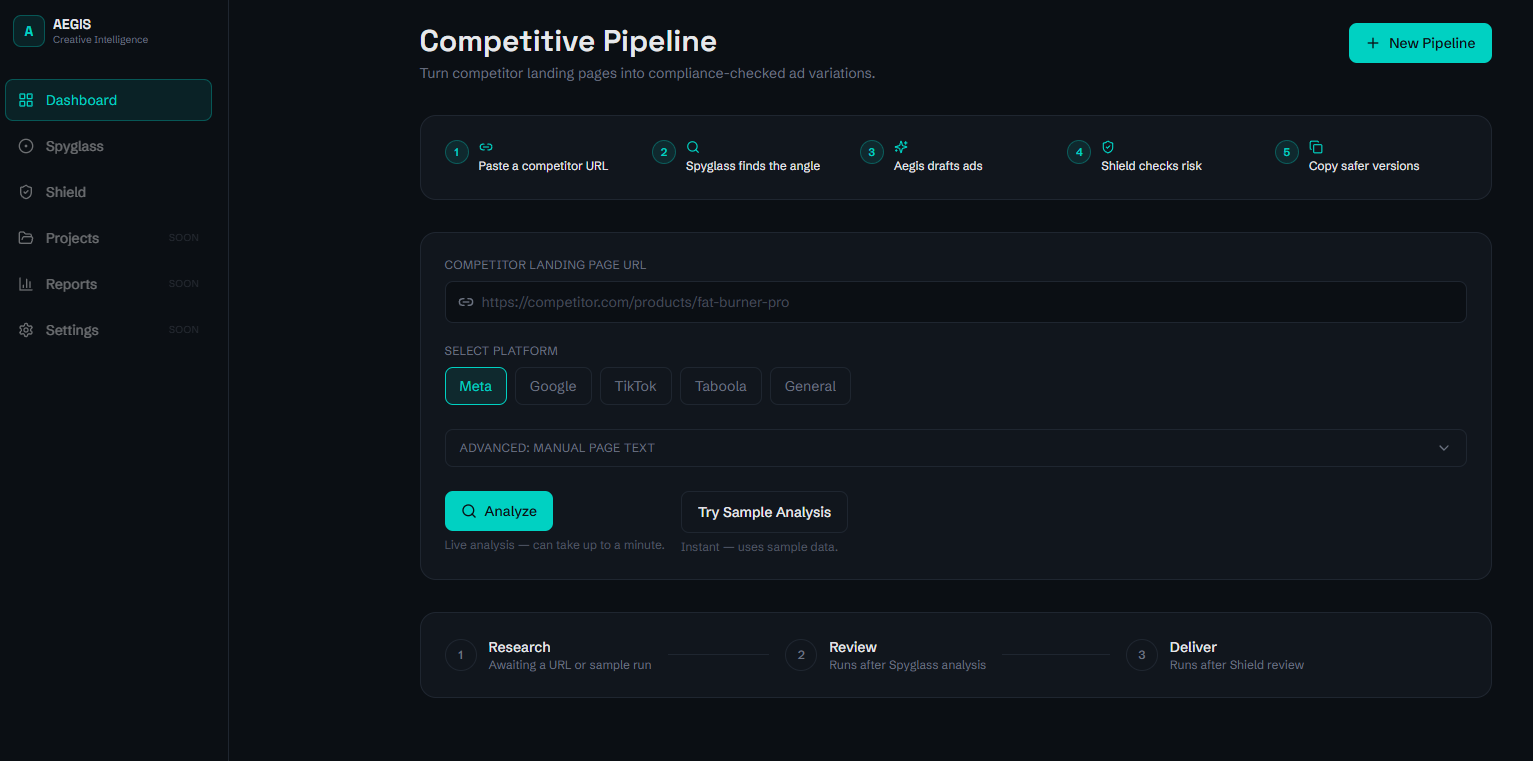
Competitive Pipeline
The main Aegis dashboard where a user starts the competitor analysis workflow and chooses the ad platform.
Case Study 01
AI creative intelligence pipeline
Aegis is an AI-assisted workflow that turns competitor landing pages into testable ad concepts, then adds a compliance-aware review layer so the output is useful without pretending the AI should make final judgment calls.
The short version
The goal was not to make AI “write ads.” The goal was to design a workflow where AI could help with the slow, messy parts of creative strategy: reading the source material, identifying positioning, generating angles, and surfacing language that needed human review.
Aegis treats AI like a structured collaborator. It gives the model a defined job, validates the shape of the output, and keeps the human reviewer in the loop where judgment, risk, and brand context matter most.
Screenshots
A few views from the working Aegis interface, showing the pipeline from competitor analysis to compliance-aware creative direction.
Competitive Pipeline
The main Aegis dashboard where a user starts the competitor analysis workflow and chooses the ad platform.
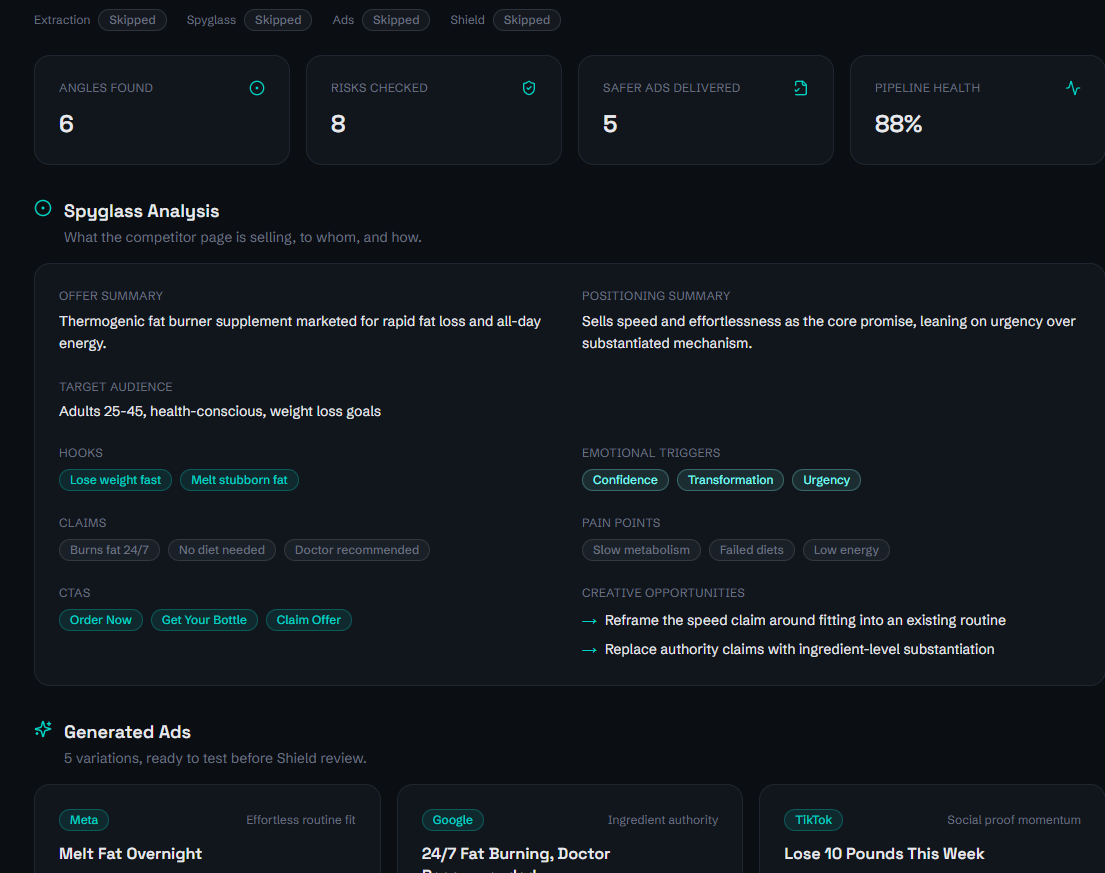
Spyglass Analysis
Structured competitor analysis showing offer, audience, hooks, claims, CTAs, emotional triggers, and creative opportunities.
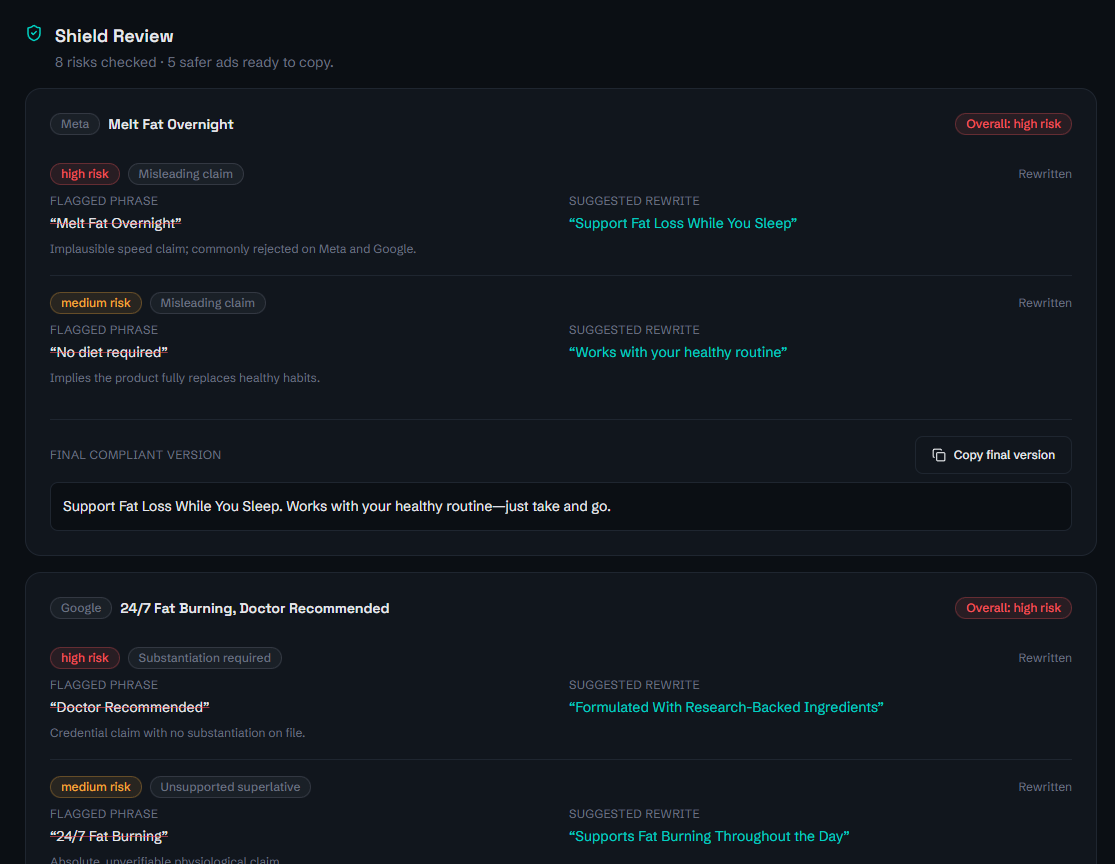
Shield Review
Risk review showing flagged phrases, risk levels, and safer rewrite suggestions for high-risk ad claims.
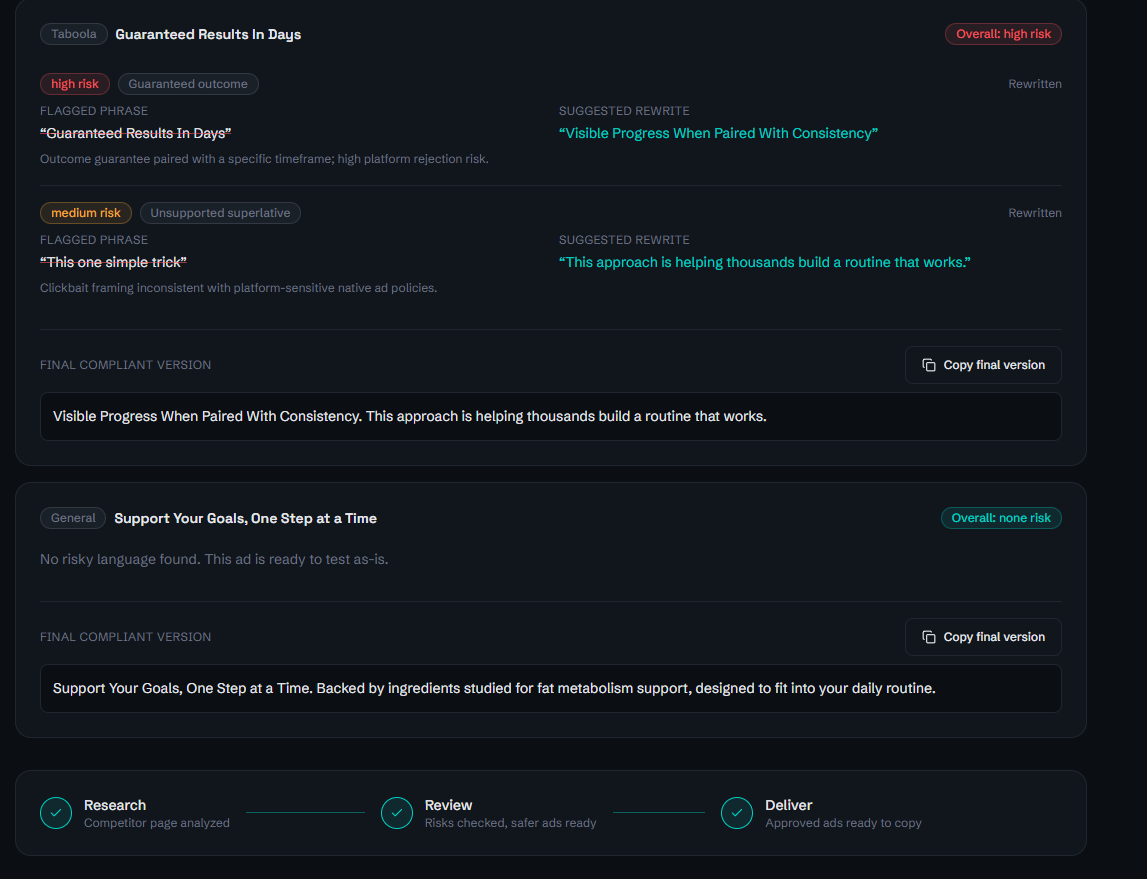
Safer Versions
The final review state with compliant rewritten versions ready to copy, including safer positioning and claim language.
Problem
The messy part of AI-assisted marketing is not getting text on the page. It is knowing where that text came from, whether it is strategically grounded, and whether it introduces risk.
Research
Landing pages reveal audience assumptions, positioning, feature priorities, proof points, emotional hooks, and conversion logic.
Creative
Without structure, AI tends to produce polished-sounding but generic concepts. Aegis keeps the ideation tied to extracted strategy.
Risk
Claims, promises, and positioning need review. The tool needed to make risk more visible, not bury it under confident copy.
Constraints
✓Built quickly as a practical prototype, not a months-long polished product.
✓Needed to show real AI workflow thinking, not just a chatbot wrapper.
✓Had to preserve human review instead of pretending AI can safely own compliance decisions.
✓Needed structured outputs so the tool felt predictable, reviewable, and easy to extend.
System Design
The important design choice was separating the work into stages. Each stage has a different purpose, which makes the output easier to inspect and improve.
01
The tool starts by reading a competitor landing page and extracting the offer, audience, claims, positioning, calls to action, and likely strategic angle.
02
It then turns that structured read into multiple ad concepts, keeping the ideas tied to the source material instead of drifting into generic AI copy.
03
A review layer flags risky claims, unsupported promises, exaggerated language, and places where human judgment should step in.
04
The final layer offers safer rewrites and directionally useful language, so the reviewer has a better starting point instead of a blank page.
Workflow Map
Input
Competitor landing page, offer, claims, audience clues, and positioning signals.
Structure
Extracted strategy, hooks, CTAs, claims, proof points, and likely customer objections.
Generate
Ad concepts, messaging angles, campaign ideas, and suggested creative directions.
Review
Risk flags, safer rewrites, and human-in-the-loop decision points.
What I Built
Interface
The interface treats the AI output as something to inspect. It separates source analysis, concepts, flags, and rewrites so the user can understand the reasoning path.
Data shape
Zod helped define predictable response shapes, which makes the pipeline easier to validate, display, debug, and eventually extend.
AI strategy
Instead of asking one giant prompt to do everything, Aegis breaks the work into smaller conceptual jobs that can be evaluated more clearly.
Risk handling
Risk review is not an afterthought. It is part of the workflow, which makes the tool feel more realistic for professional use.
Lessons
The strongest part of Aegis is not that it generates ad ideas. It is that it breaks the work into readable stages with defined expectations.
A tool like this should not hide risk. It should make risk easier to notice, discuss, and resolve before something reaches an audience.
The user needs to understand where the output came from, why it matters, and what to do with it next. That is a product design problem, not just a prompt problem.
Next Iteration
The next version would add saved projects, side-by-side competitor comparisons, clearer evidence links back to the source page, reusable brand/compliance rules, and a stronger reviewer workflow for approving, rejecting, or revising generated concepts.
I would also separate the compliance review into more explicit categories, such as unsupported claims, risky guarantees, sensitive audience assumptions, and tone mismatches.
Selected Work